Skip to content
DE EN
Subscribe

Computer Science Advanced

Upper secondary, Matura and A-level standard.

Tip: The videos also have an English audio track. On YouTube, open ⚙ Settings → Audio track.

15:40

Episode 2

Number Systems – Advanced

What you will learn

  • any base: value = digit · base^position, Horner's method as a shortcut
  • hexadecimal: 1 hex digit = 4 bits, 0x41 = 65, colour code #E08A4E = 224 / 138 / 78
  • octal and file permissions: chmod 755 = rwx r-x r-x
  • two's complement: −13 = 1111 0011, 7 − 13 = −6 with a single adder
  • range and overflow: 100 + 50 = −106, Pac-Man level 256, Ariane 5, the year 2038
  • floating point: 5.75 in IEEE 754 and why 0.1 + 0.2 = 0.30000000000000004
  • five exam traps where most points are lost
13:21

Episode 3

Huffman, UTF-8, Hamming

What you will learn

  • one bit = one yes/no question: guessing a number up to 100 in seven questions, entropy
  • UTF-8 in detail: lead bits, continuation bytes, ä = C3 A4 and the umlaut glitch
  • Huffman tree for ABRAKADABRA: 23 instead of 88 bits – and why you cannot shrink everything
  • JPEG, MP3/AAC and video: leaving out what we do not perceive
  • parity bit, EAN check digit at the checkout, IBAN
  • Hamming code (7,4): find and correct an error · Reed–Solomon in QR codes
  • five exam traps
13:16

Episode 4

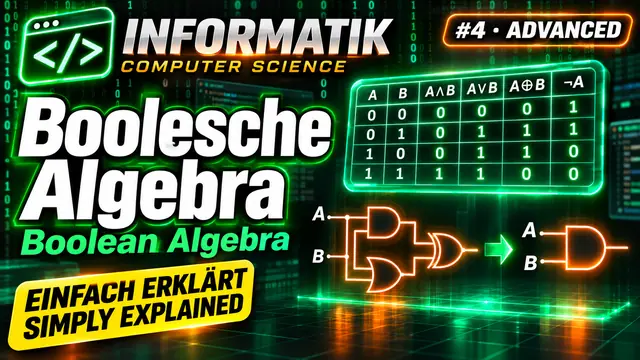
Boolean Algebra & Logic Gates – Advanced

What you will learn

  • Boolean algebra: A·B, A + B, Ā – and why 1 + 1 = 1
  • laws of Boolean algebra, the second distributive law and De Morgan
  • majority circuit: truth table → minterms → DNF → simplified circuit (with a Karnaugh map)
  • NAND does it all: NOT, AND and OR from NAND – and the Apollo computer made of NOR
  • full adder, 4-bit adder (5 + 6) and subtraction with an XOR row (7 − 3)
  • sequential circuits: SR latch, debouncing, D flip-flop, registers and counters
  • five exam traps
12:54

Episode 5

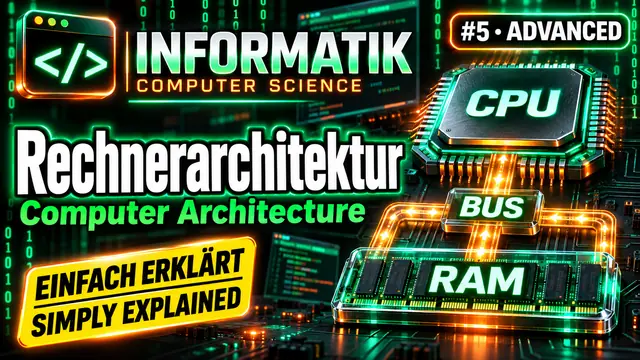
Computer Architecture – Advanced

What you will learn

  • von Neumann architecture: five parts, program and data in the same memory
  • inside the CPU: ALU, accumulator, program counter, instruction register, status flags and control unit
  • three buses – and why 32 address lines reach only 4 GiB
  • fetch → decode → execute: a mini program cycle by cycle (7 + 5 = 12)
  • memory hierarchy: if a cache access took one second, a hard disk access would take four months
  • the bottleneck, Harvard, pipelining (400 vs 103 cycles), RISC and CISC, GPUs
  • five exam traps
14:35

Episode 6

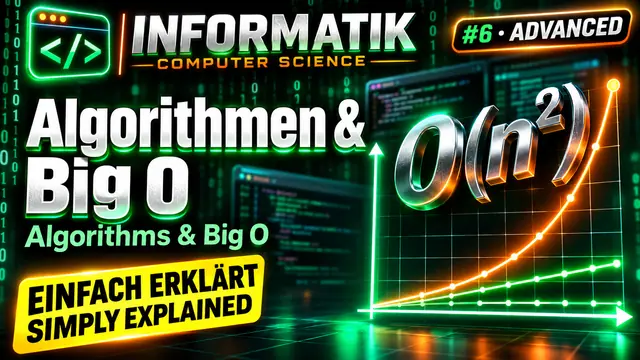
Algorithms & Big O – Advanced

What you will learn

  • counting steps instead of measuring seconds: best, average and worst case
  • linear search O(n) versus binary search O(log n): 23 in three comparisons instead of six, a million in 20
  • selection, insertion and bubble sort – and why they are quadratic
  • recursion: base case, factorial, the call stack for 4! and the Towers of Hanoi
  • merge sort: O(n log n) instead of O(n²) – 2 · 10⁷ instead of 5 · 10¹¹ steps
  • Big O notation: growth curves and a table for n = 10, 1000 and one million
  • the travelling salesperson problem, P versus NP, approximations in navigation, chess
  • five exam traps
12:19

Episode 7

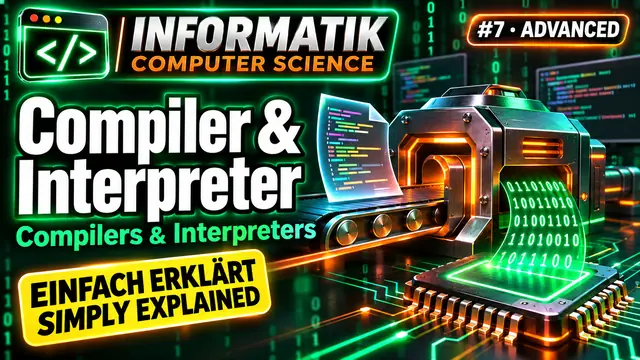
Compilers & Interpreters – Advanced

What you will learn

  • three language levels: total = a + b → LOAD, ADD, STORE → 1E 2F 3D
  • compilers (C, C++, Rust) versus interpreters · Python bytecode · Java with the JVM and JIT
  • the lexer: 17 characters become 5 tokens
  • grammar in EBNF and syntax trees: 2 + 3 · 4 = 14, (2 + 3) · 4 = 20, 8 − 2 − 3 = 3
  • reading Python bytecode with dis – and why Python computes 2 + 3 * 4 in advance
  • syntax versus semantics, logic and runtime errors
  • type systems: Java static, Python dynamic; Python strict, JavaScript lenient ("3" + 4)
  • imperative, declarative (SQL), object-oriented, functional
  • five exam traps
11:56

Episode 8

Automata & the Halting Problem – Advanced

What you will learn

  • state diagrams: a turnstile and a vending machine (€1.50, with change)
  • automata that check: is a binary number divisible by 3? 110 and 1001 step by step
  • regular expressions: [0-9]{4} for postcodes, ^ $ + * ? and a pattern for licence plates
  • why finite automata cannot check arbitrarily deep brackets – and how a stack helps
  • the Turing machine computes 1011 + 1 = 1100
  • the halting problem: the halt tester and the contrarian program
  • why there can be no perfect virus scanner
  • five exam traps
13:58

Episode 9

Data Structures – Advanced

What you will learn

  • arrays: address = start + index · size, access in O(1), insertion in O(n)
  • linked lists: nodes with pointers, re-linking two pointers
  • stacks: push, pop, peek · undo, the call stack, bracket matching (2 + [3 · 4]) · 5
  • queues: enqueue, dequeue, ring buffers, deque in Python
  • a binary search tree from 50, 30, 70, 20, 40, 60, 80 – searching for 45 in three comparisons
  • a hash table with ten buckets: Ben → 7, Anna and Nana → 2 (collision)
  • a cost table: which structure for what
  • five exam traps
11:50

Episode 10

Object-Oriented Programming – Advanced

What you will learn

  • designing a BankAccount class: owner, balance, deposit(), withdraw()
  • encapsulation: withdraw(150) is refused, withdraw(30) → €70 · Python _balance and @property, Java private
  • inheritance: Character → Knight, Archer, Mage · super().__init__()
  • polymorphism: for c in party: c.attack() – three different attacks
  • duck typing in Python
  • abstract classes with ABC and @abstractmethod · interfaces in Java
  • UML class diagrams: − private, + public, triangle, diamonds, multiplicities
  • five exam traps
16:04

Episode 11

Networking & Internet Protocols – Advanced

What you will learn

  • encapsulation: HTTP in TCP in IP in Ethernet – like letter, envelope, parcel and truck
  • MAC address, switch and ARP: “Who has 192.168.1.1?”
  • subnets: /24, /26 and /28 – network address = address AND mask
  • Dijkstra step by step: A–C–B–D–E with 10 ms
  • TCP handshake SYN, SYN-ACK, ACK · UDP for games and video calls
  • ports 80, 443, 53, 22 and sockets
  • DNS hierarchy and caching · HTTP 200, 301, 404, 500
  • NAT, port forwarding and IPv6 with 128 bits
  • https://www.example.com: DNS → TCP → TLS → GET
  • five exam traps
15:00

Episode 12

Databases & SQL – Advanced

What you will learn

  • relation, tuple, attribute, candidate key, domain
  • ER model: 1 : n with a foreign key, n : m with a junction table
  • SELECT … FROM … WHERE … ORDER BY, LIKE '%Potter%', BETWEEN, IN
  • COUNT, MIN, AVG, GROUP BY – and why HAVING instead of WHERE
  • INNER JOIN, LEFT JOIN and the cross product (9 × 6 = 54)
  • loans per book row by row – including zero
  • INSERT, UPDATE, DELETE – and DELETE without WHERE
  • transactions with COMMIT and ROLLBACK, ACID
  • anomalies and 1st, 2nd, 3rd normal form on the loan list
  • five exam traps
15:29

Episode 13

Cryptography – Advanced

What you will learn

  • confidentiality, integrity, availability, authenticity
  • Vigenère with KEY and frequency analysis
  • XOR: 0101 ⊕ 1100 = 1001 and back · one-time pad · AES with 2¹²⁸ keys
  • Diffie-Hellman with colours and with p = 23, g = 5 → secret 2
  • RSA with n = 55: 7 → 13 → 7
  • SHA-256 and the avalanche effect
  • passwords with salt, bcrypt and Argon2
  • digital signatures and signed updates
  • TLS handshake, certificates, Signal protocol, man in the middle
  • SQL injection and prepared statements · post-quantum cryptography
  • five exam traps
14:52

Episode 14

AI & Machine Learning – Advanced

What you will learn

  • three kinds of learning: labels, groups, rewards (Go, 2016)
  • apples and pears in feature space · k nearest neighbours with k = 3
  • splitting data: 70 % training, 15 % validation, 15 % test
  • the perceptron: AND gate with weights 1 and 1, bias −1.5 · the learning rule step by step
  • XOR is not linearly separable – and is solved anyway with OR, NAND and AND
  • gradient descent: F(w) = (w − 3)², w = 0 → 0.6 → 1.08 → … · learning rate too big, too small
  • spotting overfitting and stopping early
  • a spam filter with 1000 mails: accuracy 96 %, precision 75 %, recall 90 %
  • CNNs, transformers, tokens and attention
  • bias, explainability, copyright, deepfakes and the EU AI Act
  • five exam traps
14:03

Episode 15

Expression Calculator – Advanced

What you will learn

  • a compiler-style architecture: lexer → parser → evaluator · class diagram
  • the lexer as a finite automaton: “3,5” and “3.5”, operators, parentheses, signs
  • postfix (RPN): 3 4 2 1 − × + without parentheses – evaluated with a stack
  • shunting yard (Dijkstra, 1961) token by token for 3 + 4 × (2 − 1)
  • left associativity: 8 − 2 − 3 = 3 · powers are right associative: 2 ^ 3 ^ 2 = 512
  • recursive descent: expression, term, factor – the call tree for (3 + 4) × 2
  • custom exceptions, decimal instead of float – and why eval() is off limits
  • unit tests with unittest: 10 cases, 3 of them error cases
  • five exam traps
13:17

Episode 16

Database App with SQL – Advanced

What you will learn

  • requirements → an ER model with six entities, third normal form
  • PRIMARY KEY, FOREIGN KEY, NOT NULL, UNIQUE, CHECK – and PRAGMA foreign_keys = ON
  • overdue loans, top 5, never borrowed (LEFT JOIN), a subquery with NOT IN
  • the Python app with sqlite3 and a LibraryRepository class
  • SQL injection on our own practice project – and why placeholders protect you
  • passwords with salt and scrypt, roles for teachers and students
  • EXPLAIN QUERY PLAN: SCAN versus SEARCH USING INDEX – about 13× faster in our test
  • transactions: COMMIT, ROLLBACK, all or nothing
  • “people who borrowed this also borrowed …” with a self-join
  • five exam traps
15:31

Episode 17

Build Your Own CPU – Advanced

What you will learn

  • the blueprint: bus, registers, ALU, memory, program counter, instruction register, clock
  • the ALU: 8 full adders, a row of XOR gates and two's complement – 4 − 1 with the same circuit
  • the instruction set: 1 byte = 4-bit opcode + 4-bit address · LDA 14 = 0x1E · JZ 8 = 0x78
  • the control unit: micro-steps T0 to T4, control signals in a ROM, a state machine
  • the program: 3 · 4 without a multiply instruction, as a loop in 11 bytes
  • cycle by cycle: the first round with a glowing bus, then fast-forward to 12
  • 5 · 7: change just two bytes → 35 = 0x23
  • limits and real CPUs: 64 bit, caches, pipelines, ARM, RISC-V, FPGA
  • five exam traps