Skip to content
DE EN
Subscribe

Chemistry Basics

Easy to follow, grades 7–10.

Tip: The videos also have an English audio track. On YouTube, open ⚙ Settings → Audio track.

14:12

Episode 1

What Is Chemistry? Explained

What you will learn

  • chemistry is the science of substances and how they change – from breakfast to your phone battery
  • the three levels of chemistry: what you see, zooming in on the particles, writing formulas
  • chemistry, physics or biology? An ice cube, toast and chewing bread put to the test
  • telling observation from interpretation – and why you need a control experiment
  • a lab report in five parts, shown with an effervescent tablet in cold and warm water
  • experimenting safely: goggles, wafting, labelling – and never mix cleaning products
  • the nine GHS hazard pictograms and the signal words “Danger” and “Warning”
  • the dose makes the poison: caffeine worked out – two energy drinks are already too much for teenagers
  • the four most common misconceptions about chemistry
13:26

Episode 2

Matter & States of Matter Explained

What you will learn

  • substance or object? A spoon made of steel, wood or plastic
  • the profile of a substance – and why only the combination of properties counts
  • detective case: identifying four white powders with a magnifier, vinegar and heat (never taste!)
  • density = mass divided by volume: what is the screw made of? 39.5 g : 5.0 cm³ = 7.9 g/cm³
  • float or sink? Oil, ice cubes, a wooden cube – and the air in your room weighs about 60 kg
  • the particle model in 60 seconds: solid, liquid, gas
  • all six changes of state: melting, freezing, evaporating, condensing, sublimation, deposition – plus evaporation vs. boiling
  • melting and boiling points as the fingerprint of a pure substance
  • boiling and air pressure: 3000 m ≈ 90 °C, Mount Everest ≈ 70 °C, pressure cooker ≈ 120 °C
  • the four most common misconceptions about substances
12:26

Episode 3

Pure Substances & Mixtures Explained

What you will learn

  • pure substance or mixture? Why salt water has no fixed boiling point
  • homogeneous and heterogeneous: solution, alloy, gas mixture, suspension, emulsion, smoke, fog, foam
  • mass fraction: 35 g of salt in 1000 g of seawater = 3.5 % – and almost 29 kg of seawater for 1 kg of salt
  • the trick behind every separation method: use a difference in properties
  • sieving, filtering, decanting, centrifuging – from the salad spinner to gold panning
  • evaporation and distillation: salt pans, desalination plants, refineries
  • extraction, adsorption and chromatography: coffee, activated carbon, felt-tip colours
  • separation on a large scale: sewage treatment and recycling
  • the four most common misconceptions about mixtures
12:41

Episode 4

Atoms & Elements Explained

What you will learn

  • how small an atom is: ≈ 0.1 nm – a hair is about 700,000 atoms wide
  • from Democritus' “atomos” to Dalton's atomic theory: element and compound
  • reading element symbols: Fe from ferrum, Cu from cuprum, Au from aurum – and why Co is not CO
  • nucleus and shell: protons, neutrons, electrons – Rutherford's gold foil and the pea in the stadium
  • atomic number and mass number: sodium with 11 protons and 12 neutrons
  • isotopes: carbon-12, -13, -14 and why chlorine is 35.45
  • the shell model: 2 – 8 – 8 electrons and valence electrons
  • elements in your phone, your body, a pencil, a balloon and fireworks
  • the four most common misconceptions about atoms
12:38

Episode 5

The Periodic Table Explained

What you will learn

  • Mendeleev's table with gaps: eka-silicon predicted, germanium found
  • reading a box: symbol, name, atomic number, atomic mass
  • periods = number of shells, main groups = number of valence electrons
  • riddle: period 3, main group 6 – which element is it?
  • metals, metalloids, non-metals and the staircase line – silicon in chips, copper in cables
  • alkali metals: soft, stored under oil, violent with water (video only!) – and lithium in batteries
  • halogens, the salt formers: chlorine in pools, iodine in salt, fluoride in toothpaste
  • noble gases with a full outer shell: helium, neon, argon
  • trends: larger going down, smaller going right
  • the four most common misconceptions about the periodic table
13:01

Episode 6

Molecules & Compounds Explained

What you will learn

  • compound or mixture? Iron and sulfur – before and after heating (video only!)
  • the noble gas rule (octet rule): eight electrons in the outer shell
  • ions: Na⁺, Cl⁻, Mg²⁺, O²⁻ – reading the charge from the main group
  • salts and ionic lattices: hard, brittle, table salt melts at 801 °C, conducts only when dissolved or molten
  • salt formulas: MgCl₂, Al₂O₃ and CaCl₂ from charge balance
  • molecules and Lewis structures: H₂, Cl₂, H₂O, NH₃, CH₄, CO₂ – valence and double bonds
  • diamond: covalent bonds in every direction
  • metals and the electron gas: aluminium foil and copper wire
  • salt, sugar and copper compared
  • the four most common misconceptions about bonding
11:15

Episode 7

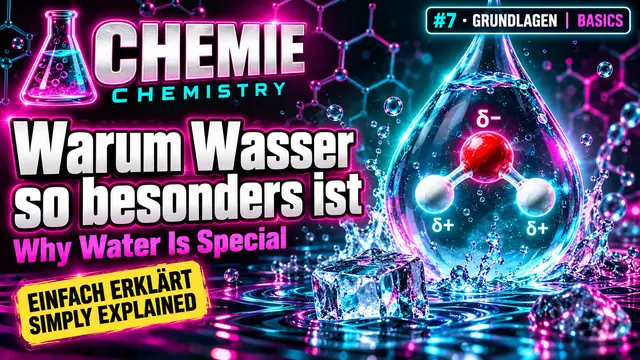
Why Water Is Special

What you will learn

  • water is not an element: electrolysis – 20 mL hydrogen, 10 mL oxygen
  • the bent molecule (104.5°) and the dipole – a water stream and a rubbed balloon
  • hydrogen bonds: why water boils only at 100 °C (hydrogen sulfide at −60 °C)
  • surface tension: water striders, a floating paper clip, pepper and dish soap
  • the anomaly: maximum density at 4 °C – 1 L of water becomes ≈ 1087 cm³ of ice
  • water as a solvent: hydration shells, 36 g salt vs 200 g sugar per 100 g water, oil stays separate
  • why dish soap removes grease
  • hard water and limescale in the kettle
  • the four most common misconceptions about water
12:07

Episode 8

Physical vs Chemical Change

What you will learn

  • physical or chemical: chocolate, ice and sugar vs toast, rust and egg
  • five signs of a reaction – and three traps (boiling water, light bulb, food colouring)
  • reactants, products and word equations: iron + sulfur → iron sulfide, candle, rust
  • exothermic and endothermic: hand warmer, candle, citric acid with baking soda, photosynthesis
  • activation energy: why your desk does not catch fire by itself
  • catalysts: the catalytic converter with platinum and enzymes in saliva
  • conservation of mass: 412.4 g closed, 411.7 g after opening – 0.7 g of carbon dioxide
  • fixed mass ratios: 7 g iron + 4 g sulfur → 11 g iron sulfide
  • the four most common misconceptions about reactions
12:07

Episode 9

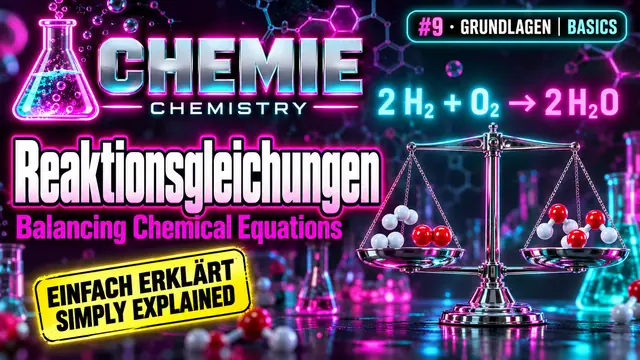
Balancing Chemical Equations

What you will learn

  • formulas: the world language of chemistry
  • subscript and coefficient: 3 H₂O = 6 H + 3 O
  • molecules from valence: CH₄, NH₃, CO₂, H₂O
  • salts from charges: NaCl, CaCl₂, Al₂O₃ – and polyatomic ions such as CO₃²⁻ (limescale) and HCO₃⁻ (baking soda)
  • the seven diatomic elements: H₂, O₂, F₂, Br₂, I₂, N₂, Cl₂
  • balancing in four steps: 2 H₂ + O₂ → 2 H₂O
  • examples: fireworks, gas stove, rust, photosynthesis, hydrogen car
  • state symbols (s), (l), (g), (aq)
  • the four most common mistakes when balancing
11:33

Episode 10

Combustion Explained

What you will learn

  • what a candle reveals: the wax vapour burns · flame zones
  • the fire triangle: fuel, oxygen, ignition temperature
  • combustion = oxidation · the glowing splint test
  • tests: a cold glass mists up, limewater turns milky
  • lack of oxygen: soot and carbon monoxide – why CO alarms save lives
  • surface area: nail, steel wool, iron powder, flour dust
  • putting out fires: oil fire – 0.2 L of water become 340 L of steam · fire classes
  • calorific values: wood, petrol, hydrogen
  • the four most common misconceptions about fire
11:43

Episode 11

Chemical Equilibrium Explained

What you will learn

  • one-way street or back and forth: wood burns, water evaporates and condenses
  • the double arrow: forward and reverse reaction
  • the covered glass: dynamic equilibrium – it keeps going, equally fast in both directions
  • the straw model: 300 mL become 60 mL and 240 mL – constant, but not equal
  • the four signs of an equilibrium
  • the soda bottle: 1 L of sparkling water releases almost 3 L of gas
  • Le Chatelier: an equilibrium shifts to counteract a change – pressure, heat, removal
  • stalactite caves, limescale in the kettle, blood and oxygen, carbon monoxide, rechargeable batteries
  • the four most common misconceptions about equilibrium
11:22

Episode 12

Acids & Bases Explained

What you will learn

  • red cabbage: an indicator from the kitchen
  • sour and soapy: lemon, vinegar, cola – soap, baking soda, washing soda
  • indicators: red cabbage, universal indicator, litmus
  • acids form hydrogen ions, bases form hydroxide ions
  • the pH scale from 0 to 14 – every step a factor of 10
  • dilution: an acid never becomes basic
  • neutralisation: acid + base → salt + water · heartburn
  • descaler, teeth, hydrangeas, swimming pool, acid rain
  • water first, then the acid – and never mix cleaners
  • the four most common misconceptions about acids and bases
12:35

Episode 13

Redox Reactions Explained

What you will learn

  • Statue of Liberty, bike, golden mask: what metals do over time
  • rust is a new substance – patina protects, rust eats holes
  • oxidation = gaining oxygen, reduction = losing oxygen
  • blast furnace and thermite: getting metals from their oxides
  • the electron view: oxidation is loss, reduction is gain (OIL RIG)
  • noble and base metals: the reactivity series from potassium to gold
  • preventing rust: paint, galvanising, stainless steel – and why road salt hurts
  • electricity from a lemon – how many lemons does an LED need?
  • the four most common misconceptions about redox
11:38

Episode 14

Organic Chemistry Basics

What you will learn

  • carbon, the builder: four bonds, chains, rings
  • alkanes: methane, ethane, propane, butane – and the formula CₙH₂ₙ₊₂
  • crude oil: fractional distillation into gas, petrol, kerosene, diesel, heating oil, bitumen
  • 1 litre of petrol → 2.3 kg of CO₂: combustion and climate
  • ethene: why ripe bananas soften avocados
  • alcohols: fermentation, bread dough, disinfectant – and why methanol is toxic
  • wine turns into vinegar: functional groups
  • plastics: polymers, thermoplastics, recycling codes, microplastics
  • the four most common misconceptions about organic chemistry
10:38

Episode 15

Kitchen Chemistry Lab

What you will learn

  • the lab box: what goes in – and what never does (drain cleaner, bleach, medicines)
  • the five lab rules and safe disposal
  • asking a research question: variable, constants, control experiment
  • red cabbage titration: which vinegar needs the most baking soda?
  • evaluating: measure three times, average, sources of error, bar chart
  • the show: volcano, CO₂ extinguisher, rainbow series, milk plastic, lemon battery
  • presenting: the research poster
  • looking back: every lab box of the series
  • the three most common mistakes when experimenting