Skip to content
DE EN
Subscribe

Physics Basics

Easy to follow, grades 7–10.

Tip: The videos also have an English audio track. On YouTube, open ⚙ Settings → Audio track.

15:32

Episode 1

Speed & Acceleration Explained

What you will learn

  • motion needs a frame of reference – are you sitting still on the train or doing 120 km/h?
  • measuring distance and time – and why you measure more than once
  • calculating speed: v = s / t, in m/s and km/h (times 3.6)
  • average vs. instantaneous speed: speedometer, speed cameras, average-speed checks, running pace
  • reading a distance-time graph: steep, flat, horizontal
  • acceleration: a = Δv / Δt – braking counts too
  • reaction distance: why 2 seconds on your phone means almost 28 metres driving blind
  • the three most common mistakes
13:38

Episode 2

Forces Explained

What you will learn

  • recognising a force by its effect: deformation or a change in motion
  • measuring forces: spring balance, newtons – and why 100 g of chocolate weighs about 1 N
  • drawing and adding force arrows (tug of war: 600 N against 500 N)
  • inertia: why you lurch forward in the bus – seat belts and the ketchup bottle
  • friction: static, sliding and rolling friction – and why friction is useful
  • balanced forces: even at a constant 100 km/h
  • forces come in pairs: skateboard, swimming, rocket
  • F = m · a: the skateboarder with 50 kg and 100 N
  • the three most common mistakes
11:46

Episode 3

Levers & Torque Explained

What you will learn

  • pivot and lever arm – why the handle is on the outside
  • torque M = F · a: a wheel nut at 120 N·m and the extended wrench
  • the law of the lever on a seesaw: 300 N at 2 m against 750 N at 0.8 m
  • types of levers: scissors, wheelbarrow, nutcracker – and your forearm
  • the golden rule of mechanics: less force means more distance
  • the pulley system: lifting 800 N with 200 N
  • centre of gravity and tipping: crane with counterweight, roof box
  • the three most common mistakes
11:37

Episode 4

Gravity Explained

What you will learn

  • everything attracts everything – even you and your phone
  • mass (kg) and weight (N) – and why “I weigh 60 kg” is really your mass
  • F_G = m · g: Earth ≈ 10 N/kg, Moon 1.62, Jupiter 24.8
  • hammer and feather on the Moon – without air everything falls equally fast
  • air resistance: skydivers at 200 km/h and at 20 km/h
  • 10 m/s faster every second – your phone hits the floor in 0.4 s
  • weightless in the ISS – although gravity there is almost 90 %
  • the three most common mistakes
11:27

Episode 5

Energy, Work & Power Explained

What you will learn

  • forms of energy – and what a joule has to do with a bar of chocolate
  • work W = F · s: why holding still is no work, even if it is exhausting
  • potential energy m · g · h – from the bookshelf to the pumped-storage power plant
  • kinetic energy ½ · m · v²: twice as fast, four times the energy
  • conservation of energy: roller coaster, pendulum and trampoline
  • efficiency: electric motor 80 %, your muscles about 25 %
  • power P = W : t – 180 W walking, 540 W running
  • the three most common mistakes
12:58

Episode 6

Pressure Explained

What you will learn

  • p = F : A – why the bed of nails doesn't hurt
  • stiletto heel vs. elephant: 60 bar vs. 1 bar
  • density ρ = m : V – and what a cube is made of
  • in water: about 1 bar more every 10 m, only the depth matters
  • air pressure: we live at the bottom of an ocean of air
  • straw and suction cup: you don't suck, the air pushes
  • hydraulics: lift a car with the force for 10 kg
  • the three most common mistakes
11:33

Episode 7

Buoyancy Explained

What you will learn

  • a stone on a spring scale: 20 N in air, 12 N in water
  • where buoyancy comes from – the pressure is greater at the bottom
  • Archimedes and “Eureka”: buoyancy = weight of the displaced water
  • sinking, hovering, rising, floating – a comparison of forces
  • the iceberg: almost 90 % under water · the Dead Sea carries you
  • the clay boat – and why a steel ship floats
  • submarine, fish, life jacket and hot-air balloon
  • the three most common mistakes
14:10

Episode 8

Heat & Temperature Explained

What you will learn

  • particles in motion: the warmer, the faster
  • sparkler vs. bathtub: temperature is not heat
  • Celsius and Kelvin: 0 K = −273.15 °C
  • expansion joints: a 100 m steel bridge grows by about 6 cm in summer
  • water is densest at 4 °C – that's why lakes freeze from the top
  • the temperature stays constant while melting and boiling
  • conduction, convection, radiation – and the answer to the railing puzzle
  • thermos flask, down jacket, double glazing
  • Q = c · m · ΔT: bringing 1 litre of water to the boil takes 335 kJ
  • the four most common mistakes
11:29

Episode 9

Sound Explained

What you will learn

  • everything that sounds vibrates: loudspeaker, tuning fork, guitar string, rice on a drum
  • alarm clock in a bell jar: no air, no sound – space is silent
  • the sound wave: compressions travel, the particles only move back and forth
  • 343 m/s in air, 1480 m/s in water – thunder trick: seconds divided by 3 = kilometres
  • frequency in hertz: concert pitch A = 440 Hz, hearing range 20 Hz to 20 kHz, ultra- and infrasound
  • amplitude and decibels: +10 dB ≈ twice as loud, above 85 dB damages your hearing
  • echo, echo sounding and bats
  • guitar, flute, octave and overtones – where timbre comes from
  • the three most common mistakes
11:25

Episode 10

Light & Color Explained

What you will learn

  • light enters the eye – and takes 8 minutes 20 seconds from the Sun
  • umbra and penumbra, solar and lunar eclipses
  • angle of incidence = angle of reflection – and what a mirror really swaps
  • blind spot: why cyclists should never wait next to a turning truck
  • refraction: the bent straw and the coin in the cup
  • total internal reflection: how the internet travels through glass fibres
  • converging and diverging lenses, magnifier, eye and glasses
  • prism and rainbow: white light is a mixture of all colours
  • your screen mixes everything from red, green and blue
  • the four most common mistakes
12:43

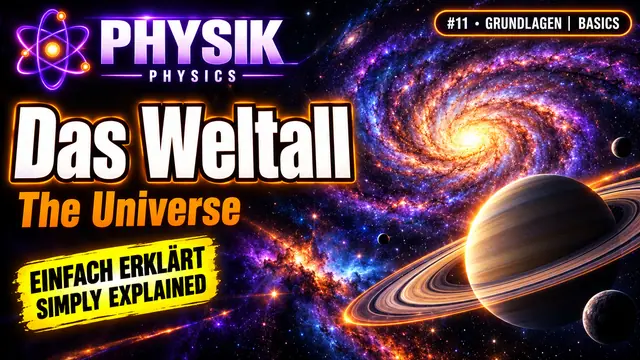
Episode 11

The Universe Explained

What you will learn

  • day and night: we are turning – at the equator at more than 1600 km/h
  • seasons: it is the tilted axis (23.4°), not the distance from the Sun
  • phases of the Moon, solar and lunar eclipses – and why the Moon turns red
  • a scale model: Sun = football, Earth = peppercorn 24 m away, Neptune 700 m away
  • the light-year: a distance of about 9.5 trillion kilometres
  • Proxima Centauri: 4.2 light-years – 75,000 years for Voyager
  • stars: red ones are cooler, blue ones hotter – and the Sun is one of them
  • the Milky Way, billions of galaxies and the Big Bang 13.8 billion years ago
  • spotting the ISS and GPS satellites
  • the three most common mistakes
12:23

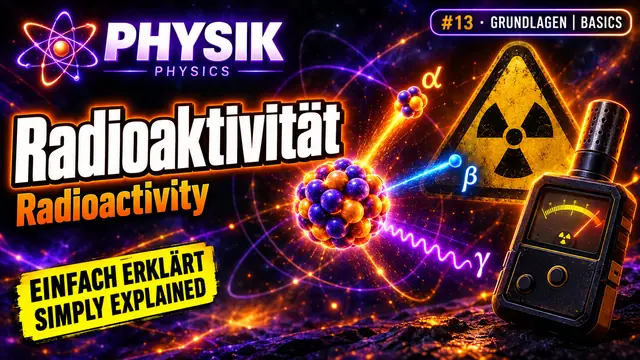
Episode 13

Radioactivity Explained

What you will learn

  • atoms are almost empty: if the atom were a stadium, the nucleus would be a pea
  • protons, neutrons, electrons – and what isotopes are (C-12 and C-14)
  • alpha, beta, gamma: paper, aluminium, lead
  • making radiation visible in a cloud chamber
  • half-life to play along: 100 dice, sixes drop out
  • Ötzi and radiocarbon dating: 53 % C-14 → about 5,300 years
  • radon in the basement, X-rays, CT scans, flights – and why airing helps
  • radiation protection: distance, shielding, short time
  • the three most common mistakes
12:08

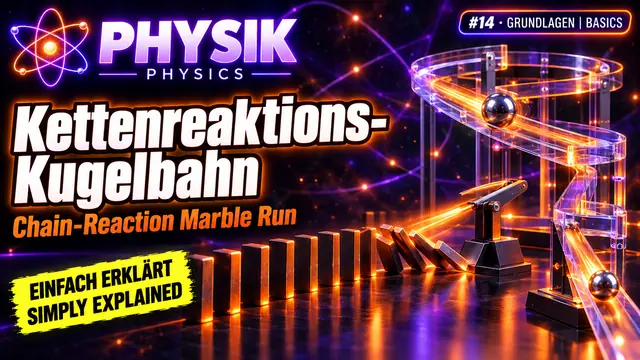
Episode 14

Building a Chain-Reaction Marble Run

What you will learn

  • the plan: every station costs height – that's why a new marble starts at each station
  • household materials: pool noodles, cardboard, marbles, syringes, ice cubes, mirrors
  • eleven stations: ramp, dominoes, seesaw, drop tower, loop, hydraulics, float, ice timer, sound track, periscope, spiral funnel
  • measuring with phyphox: 1 m in 0.8 s → 1.25 m/s, drop tower ≈ 0.45 s, loop start ≈ 20 cm
  • troubleshooting: at least 5 cm of slope per metre, a wall in the curve, test each station on its own
  • the challenge: more than 60 seconds run time – Rube Goldberg machines
  • looking back: the whole physics series in one marble run