Skip to content
DE EN
Subscribe

Physics Advanced

Upper secondary, Matura and A-level standard.

Tip: The videos also have an English audio track. On YouTube, open ⚙ Settings → Audio track.

16:50

Episode 1

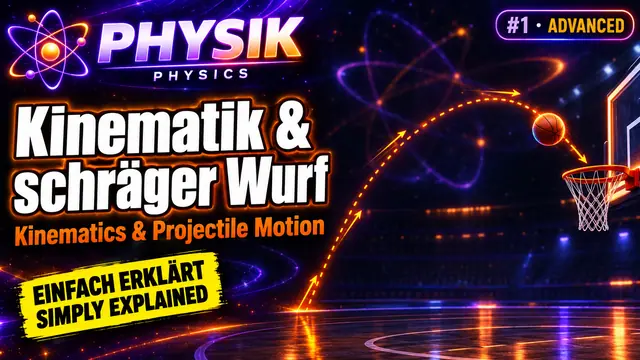
Kinematics & Projectile Motion – Advanced

What you will learn

  • equations of motion: s = ½·a·t² + v₀·t + s₀ – and where the ½ comes from
  • the time-independent equation v² = v₀² + 2·a·s: braking and stopping distances at 50 and 100 km/h
  • translating graphs: gradient downwards, area upwards (a lift measured with phyphox)
  • free fall with g = 9.81 m/s² – the hammer and the feather on the Moon
  • independence of motion: which phone lands first?
  • projectile motion: time to the top, maximum height, range – and when 45° really is optimal
  • measurement uncertainty: mean, half range, sensible rounding
  • the four most common exam traps
14:19

Episode 2

Newton's Laws of Motion – Advanced

What you will learn

  • Newton's three laws: inertia, F_net = m · a, action and reaction
  • why interaction forces never cancel – and how a rocket flies in space
  • drawing free-body diagrams and choosing a clever coordinate system
  • resolving forces: the suitcase pulled with 80 N at 40°
  • inclined plane: parallel component with sin, normal force with cos – and the 0° check
  • friction: F_f = μ · F_N, the crate on a 25° ramp, angle of repose tan α = μ
  • lift and scales: F_N = m · (g ± a), weightless in a free-fall tower
  • the four most common exam traps
13:50

Episode 3

Circular Motion & Torque – Advanced

What you will learn

  • T, f, ω and v = ω · r – and why we use radians
  • a washing machine at 1200 rpm: the laundry moves at over 100 km/h
  • centripetal acceleration a = v²/r: salad spinner 40 g, lab centrifuge 1000 g
  • centripetal force in a car: why you slide out of a bend in the wet
  • centrifugal force: a fictitious force in the rotating frame
  • the loop: v_min = √(g · r) – about 36 km/h for a 10 m radius
  • equilibrium of rigid bodies: a plank on two trestles
  • rotational power: P = M · ω
  • the four most common exam traps
13:08

Episode 4

Gravitation & Orbital Mechanics – Advanced

What you will learn

  • apple and Moon: the same force, weaker with 1/r²
  • the law of gravitation – and why two people attract each other with only 2.8 · 10⁻⁷ N
  • weighing the Earth: g = G · M / R² gives M ≈ 6 · 10²⁴ kg
  • the ISS: v = √(G · M / r) = 7.66 km/s, one orbit in 93 minutes
  • geostationary: an orbital radius of 42,000 km – and why it has to be a sidereal day
  • Kepler: ellipses, equal areas, T² / a³ = constant – Mars takes 1.88 years
  • tides: the tidal power station on the Rance with 240 MW
  • the four most common exam traps
15:46

Episode 5

Energy & Momentum – Advanced

What you will learn

  • W = F · s · cos φ – and why work is the area under the curve
  • elastic energy ½ · D · s²: the spring gun fires at 10 m/s
  • energy balance: loop starting height 2.5 · r sliding, 2.7 · r rolling
  • impulse F · Δt = Δp: the airbag cuts the force from 7000 N to 700 N
  • conservation of momentum: skater, medicine ball and rocket
  • rear-end collision: 40 % of the kinetic energy goes into bent metal
  • elastic collision: equal masses swap their velocities
  • Pelton turbine: double momentum transfer, maximum power at u = v/2
  • the four most common exam traps
14:24

Episode 6

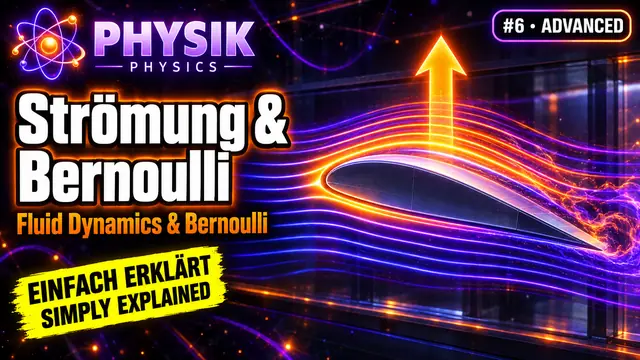
Fluid Dynamics & Bernoulli – Advanced

What you will learn

  • p = ρ · g · h – derived from a water column, 28 bar at the foot of a dam
  • Q = A · v and A₁ · v₁ = A₂ · v₂: why the garden hose with a nozzle squirts
  • Bernoulli: p + ½ · ρ · v² + ρ · g · h = constant
  • Torricelli: v = √(2 · g · h) – as fast as in free fall
  • Venturi, atomiser, Pitot tube and the ball in a hair-dryer jet
  • how planes fly – and why “equal transit time” is a myth
  • drag ~ v², power ~ v³: 240 W at 36 km/h
  • turbine nozzle: 18 % lost in hose and nozzle
  • the four most common exam traps
15:48

Episode 8

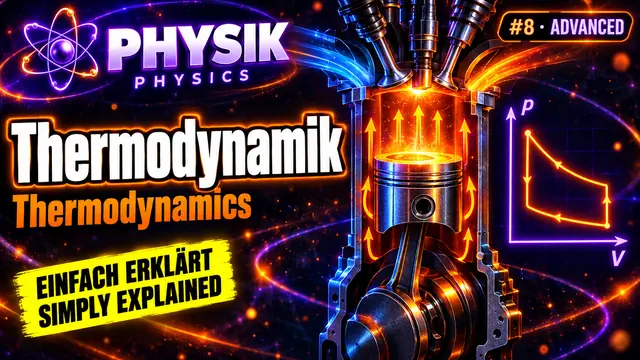
Thermodynamics – Advanced

What you will learn

  • mixing temperature: 200 g of tea at 80 °C + 50 g of milk at 5 °C → 65 °C
  • vaporising takes more than five times the energy of heating from 0 to 100 °C
  • p · V = n · R · T: a bike tyre in the sun – 3.4 instead of 3 bar gauge pressure
  • kinetic theory: Ē = 3/2 · k · T, air molecules at about 500 m/s
  • first law ΔU = Q + W: bike pump, spray can and cloud formation
  • heat engine: the enclosed area in the p-V diagram is the work
  • Carnot: η_max = 1 − T_c / T_h – at most 65 % for the power plant
  • second law and entropy: heat flows by itself only from hot to cold
  • heat pump: coefficient of performance up to 8.8, real-world 3–4
  • turbine module 8: our mini turbine's efficiency 43 %, hydropower 90 %
  • the four most common exam traps
15:22

Episode 9

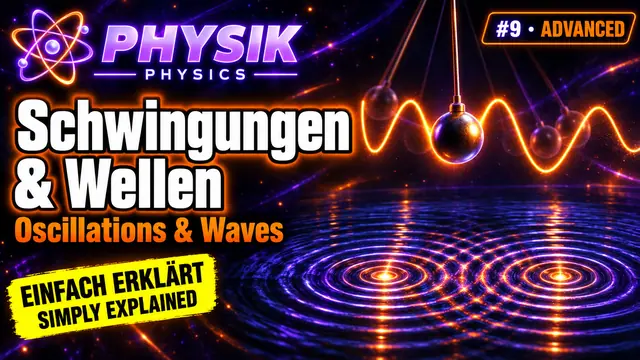
Oscillations & Waves – Advanced

What you will learn

  • y = ŷ · sin(ω · t) – the shadow of circular motion, ω = 2π · f
  • spring pendulum T = 2π · √(m/k): a car bounces about once per second
  • simple pendulum T = 2π · √(l/g): swing 3.2 s, seconds pendulum 0.99 m
  • resonance: Millennium Bridge, wine glass, the 600-tonne damper in Taipei 101
  • c = λ · f – the source sets the frequency, the medium the speed
  • interference: noise cancelling and beats when tuning
  • standing waves: L = n · λ/2 – low E string 82.4 Hz, 107 m/s, octave at the 12th fret
  • Doppler effect: a 900 Hz siren heard as 956 Hz and 850 Hz
  • turbine module 9: imbalance and resonance at 480 rpm
  • the four most common exam traps
18:26

Episode 10

Lenses & Wave Optics – Advanced

What you will learn

  • n = c₀/c and n₁ · sin α₁ = n₂ · sin α₂ – 45° in air becomes 32° in water
  • critical angle: water 48.8°, glass 41.8°, optical fibre 80.6°
  • dispersion: prism, rainbow at 42° and the reversed secondary bow at 51°
  • ray diagrams: parallel, focal and central ray – camera, projector, magnifier
  • 1/f = 1/u + 1/v: a phone camera with f = 4 mm – a person's image is 3.6 mm tall
  • optical power in dioptres: reading glasses +2 D, glasses for short sight −2.5 D
  • eye, magnifier (25 cm/f), microscope 400×, telescope 50×
  • light is a wave: diffraction, double slit (Young 1801), grating d · sin θ = n · λ
  • experiment: measure a laser pointer's wavelength with a CD – about 650 nm
  • turbine module 10: measuring rotational speed with light and the stroboscopic effect
  • the four most common exam traps
14:57

Episode 11

Theory of Relativity – Advanced

What you will learn

  • Michelson–Morley (1887) and Einstein's two postulates (1905)
  • simultaneity is relative: two lightning strikes, one train
  • light clock and Pythagoras: γ = 1/√(1 − v²/c²) – 1.25 at 0.6 c, 7.1 at 0.99 c
  • time dilation Δt = γ · Δt₀: muons from 15 km up reach the ground
  • length contraction L = L₀/γ: 100 m become 60 m at 0.8 c
  • a trip to a star: 10 years for Earth, 8 years for the crew – and the twin paradox
  • 0.6 c + 0.6 c is only 0.88 c
  • E = mc²: 1 g of mass = 9·10¹³ J = 25 GWh – the Sun, nuclear power, CERN
  • GPS: −7 µs + 45 µs = 38 µs per day ≈ 11 km error
  • the four most common exam traps
14:59

Episode 12

Quantum Physics – Advanced

What you will learn

  • the puzzle of the photoelectric effect – why the wave model fails
  • E = hf and E = hc/λ: red photon 1.9 eV, UV photon 5 eV
  • Einstein's line E_k = hf − φ: zinc, threshold wavelength 288 nm, stopping voltage 0.7 V
  • a 1 mW laser pointer emits 3.3·10¹⁵ photons per second
  • why UV gives you sunburn – and infrared doesn't
  • the double slit with single particles: dots that add up to a wave pattern
  • matter waves λ = h/p: electrons 0.12 nm, a tennis ball 2·10⁻³⁴ m
  • the uncertainty principle Δx·Δp ≥ h/(4π) – and why the electron doesn't fall into the nucleus
  • turbine module 12: the solar cell as a competitor
  • the four most common exam traps
15:21

Episode 13

Atomic & Nuclear Physics – Advanced

What you will learn

  • from Thomson via Rutherford to Bohr: how the nucleus was discovered
  • line spectra: Eₙ = −13.6 eV/n², the red H-alpha line at 656 nm, helium found in sunlight
  • nucleons, mass number, atomic number, the strong nuclear force and the chart of nuclides
  • decay equations: ²³⁸U → ²³⁴Th + ⁴He, β⁻: n → p + e⁻ + antineutrino
  • decay law N = N₀·(½)^(t/T½) = N₀·e^(−λt), activity in becquerel
  • radiocarbon: 30 % C-14 left → about 10,000 years
  • mass defect: helium-4 is 0.030 u lighter than its parts → 28.3 MeV
  • fission: 1 g U-235 = 8.2·10¹⁰ J ≈ 23 MWh ≈ 2.8 t of coal
  • fusion: the Sun, deuterium + tritium → 17.6 MeV, ITER
  • turbine module 13: the steam turbine in a nuclear power plant
  • the four most common exam traps
12:58

Episode 14

Building a Water Turbine – Advanced

What you will learn

  • design: Pelton wheel R = 5 cm, 8 spoon buckets, shaft r = 1 cm, tank 2.0 m above a 4 mm nozzle
  • hydraulic power: 1 L in 14 s → Q = 7.1·10⁻⁵ m³/s, v = Q/A ≈ 5.7 m/s, P = ½ρQv² ≈ 1.15 W
  • mechanical power: lifting 200 g by 1 m in 4 s → 0.49 W, torque 0.020 N·m, ω = 25 rad/s
  • efficiency with uncertainty: η = (43 ± 4) %, whole system ≈ 35 %
  • optimising: best bucket speed v/2 – with 100 g the efficiency rises to ≈ 53 %
  • limits: runaway speed, resonance, why big turbines reach about 90 % (Bieudron, almost 1,900 m head)
  • the four most common exam traps